

Before the words were spoken aloud in Galveston, Texas on June 19, 1865,
the body already knew something had shifted. Our ancestors felt it in their
feet, their hands, a sudden loosening in the chest. Freedom — real, proclaimed,
undeniable — had finally arrived. Two and a half years late. But it arrived.
Juneteenth is not just a date on the calendar. It is ancestral memory — alive
in our bodies, carried across generations, passed down through the way our
grandmothers hummed in the kitchen, through the way our elders gathered and
broke bread and refused, always refused, to let joy be taken from them.
When Union General Gordon Granger read General Order No. 3 in Galveston,
enslaved African Americans in Texas were the last to receive the news of what the
Emancipation Proclamation had declared in January 1863. The delay was not
accidental. It was a system protecting itself. But even systems built on
cruelty cannot outlast a people rooted in spirit.
At Ubuntu Village, we hold Juneteenth as a sacred threshold — a day of
remembrance, yes, but also of reckoning, renewal, and radical joy. Because
the Ubuntu philosophy at the heart of our work — I Am Because We Are.
And Together, We Heal. — teaches us that freedom is never individual.
It is communal. It is relational. It is intergenerational.
The Body Remembers: Juneteenth as Ancestral Healing
The science of epigenetics tells us what our grandmothers already knew:
trauma is not just a memory — it is a biological inheritance. The stress
hormones of captivity, the hypervigilance of survival, the grief of
separation — these lived in the cells of our ancestors, and traces of that
story live in us still.
But here is what epigenetics also reveals: healing is heritable too.
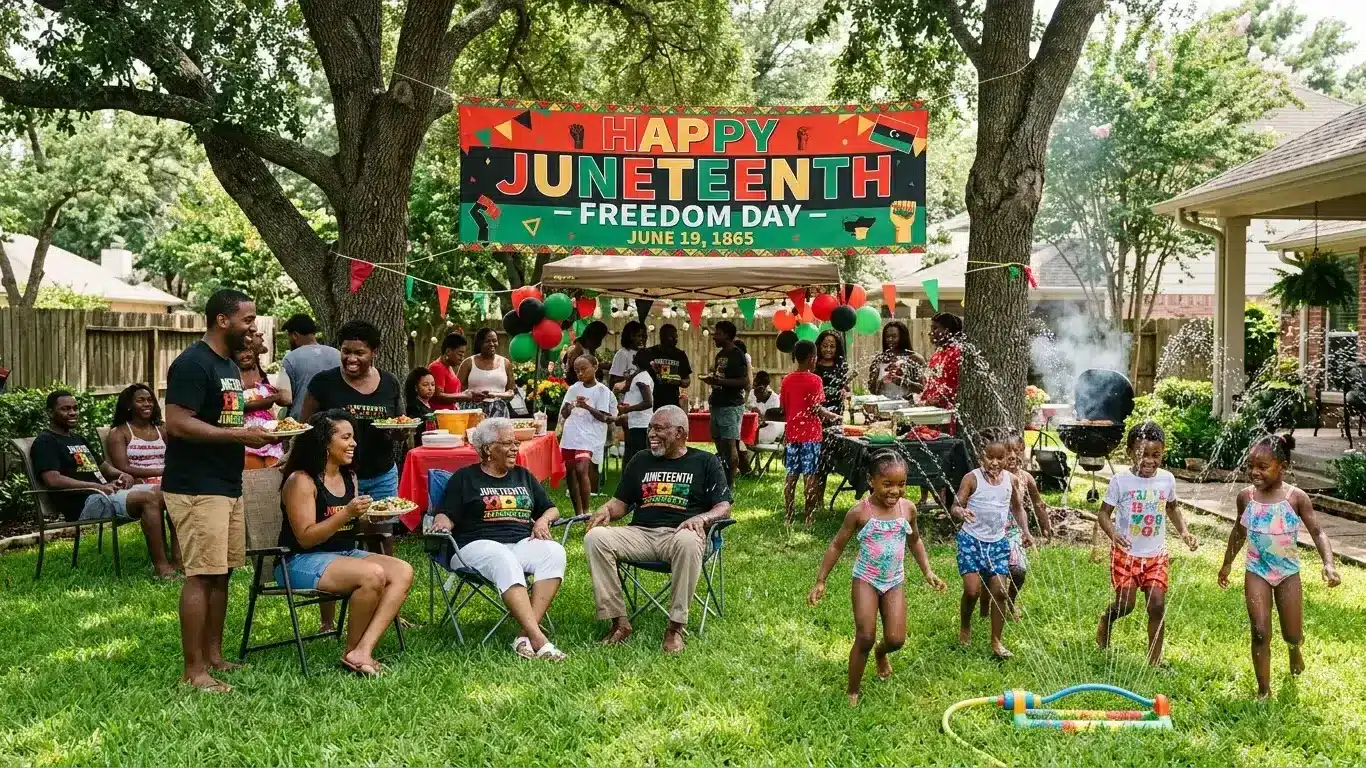
The joy of Juneteenth — the barefoot dancing, the gospel singing, the red
soda water and strawberry pie, the children running free — that joy was
not frivolous. It was medicinal. It was our ancestors rewriting their nervous
systems in real time, telling their bodies: You are safe now. We are
together. We are free.
When we celebrate Juneteenth, we are not just looking backward. We are
completing something. We are continuing the healing they began. As science continues to learn what the body carries from those who came before us, the ancestral medicine of communal celebration becomes more urgent, not less.
“Freedom is not a destination. It is a practice —
tended daily, in community, across generations.”
Ubuntu Village | Juneteenth 2026
Joy Is Revolutionary: How Our Ancestors Celebrated Freedom
From the very first Juneteenth celebrations in Texas, Black communities
understood something profound: joy is not a reward for surviving
oppression — it is a weapon against it. The early celebrations
were vibrant and deliberate. Church gatherings. Communal feasts. Music
that moved from the gut. Prayer that shook the room.
As Juneteenth spread beyond Texas — carried by migrating Black families
who took the tradition with them to California, Illinois, Michigan, and New York —
it became a living thread of cultural continuity. Even when state
legislatures refused to recognize it, even when employers denied workers
the day off, communities found ways to gather. Because gathering was resistance.
Because memory is resistance. Because joy, in the face of systems designed
to crush it, is the most revolutionary act of all.
In East Harlem, where Ubuntu Village is rooted, this spirit of communal
celebration lives on. We see it in block parties and storefront churches,
in murals painted on community center walls, in the way neighbors show up
for each other across difference. This is Juneteenth made local, made
present, made ours.
What Juneteenth teaches us
|
01 Memory Is Medicine Honoring the past is not nostalgia — it is nourishment. When we remember our ancestors, we strengthen ourselves for the work ahead. |
02 Freedom Is Communal No one is free until we are all free. Ubuntu philosophy insists on this: I Am Because We Are. Liberation must be collective to be real. |
03 Joy Is Non-Negotiable Our ancestors celebrated even in hardship. That joy was not denial — it was a declaration. We carry that same right to delight, rest, and flourishing. |
I Am Because We Are: Ubuntu Philosophy and the Promise of June 19
The Ubuntu philosophy — originating in Southern and East African traditions —
speaks a truth that Juneteenth embodies: personhood is inseparable
from community. You cannot be fully yourself in isolation. Your
healing, your freedom, your flourishing are woven into the healing, freedom,
and flourishing of those around you.
This is why Ubuntu Village does not approach Juneteenth as a single day of
recognition. We approach it as a living practice. In East Harlem, our
ancestral wellness programming invites community members — especially those
navigating intergenerational trauma — to understand their healing as both
personal and collective. In Uganda and Kenya, our solar energy access work
and digital storytelling initiatives root themselves in the same principle:
when the community rises, every individual rises with it.
June 19 asks us: who in your community is still waiting for the news of
their freedom? Who has been told — by systems, by silence, by poverty,
by inadequate healthcare, by environmental harm — that liberation does not
yet include them? Juneteenth is not a completed story. It is an active
invitation to finish what was started.
How Ubuntu Village Marks Juneteenth: Presence, Practice, Partnership
For Ubuntu Village, Juneteenth is not an occasion. It is an orientation — a way of moving through the world that shows up in our work every day of the year.
In East Harlem, that looks like Miss Gloria, a longtime community member in her seventies, who told us after one of our ancestral wellness sessions: “I didn’t know I was still carrying all of that. I thought I was fine.” She wasn’t broken — she was burdened. And the community held her while she set it down. That is what we mean when we say community is the medicine. Not a program. Not a pamphlet. People, present, for each other.
In Uganda, our Solar Power Initiative — in partnership with BrightLife and FINCA Uganda — is bringing clean energy to rural households that have long been passed over by systems that were never designed with them in mind. Seventy families. Light after dark. Children who can study past sunset. Because we believe what Juneteenth insists: freedom is not only spiritual. It requires material ground to stand on. Electricity. Clean water. Economic dignity. These are not luxuries — they are the conditions that make liberation livable.
In Kenya and Nigeria, our digital storytelling work continues to center community voices — the ones history has cropped out of the frame. We do not tell stories about these communities. We build the infrastructure for them to tell their own.
And we celebrate — fiercely, joyfully, without apology — every person who shows up to this work. Our community members. Our partners. Our donors, who stand with us as collaborators, not rescuers. You are not outside this story looking in. You are in it. This freedom is collective. This healing belongs to all of us.
Freedom Is a Practice.
Help Us Practice It Together.
Your gift to Ubuntu Village supports ancestral wellness programming in East
Harlem, solar energy access in rural Uganda, and digital storytelling that
centers community voices. This Juneteenth, invest in collective liberation.
Give to Ubuntu Village
Explore our work: Solar Power Initiative
| Medicine of the Senses
On June 19, 1865, a door opened that no force on earth could ever close again.
Our ancestors walked through it — not into a perfect world, but into the
possibility of one. That possibility is our inheritance. That work is our
offering to them.
Happy Juneteenth. May you feel the freedom in your body. May you carry it
into your community. May we build, together, the world our ancestors dared
to dream of from the other side of that door.
I Am Because We Are. And Together, We Heal.
References
- Britannica Editors. Juneteenth. Encyclopædia Britannica. britannica.com/topic/Juneteenth
- National Museum of African American History and Culture. The Historical Legacy of Juneteenth. Smithsonian Institution. nmaahc.si.edu
- History.com Editors. Juneteenth. A&E Television Networks. history.com/topics/holidays/juneteenth
- Dias, B.G., & Ressler, K.J. (2014). Parental olfactory experience influences behavior and neural structure in subsequent generations. Nature Neuroscience, 17(1), 89–96. nature.com/articles/nn.3594
- Opal Lee Foundation. The Grandmother of Juneteenth. opallee.com
- Gates, Henry Louis Jr. What Is Juneteenth? PBS African Americans: Many Rivers to Cross. pbs.org
Related Reading
- ‣ Epigenetics and Ancestral Memory: What Your Body Remembers
- ‣ The Body Keeps the Ancestors
- ‣ Juneteenth 2026: What Freedom Feels Like in the Body
- ‣ African Liberation Day: Ubuntu and Ancestral Freedom
About the author

Michele Mitchell
Founder, President & CEO — Ubuntu Village Inc.
Michele Mitchell is the Founder, President, and CEO of Ubuntu Village Inc., a 501(c)(3) nonprofit empowering communities across the African diaspora through ancestral wisdom, public health advocacy, and digital innovation — with active programs across East Harlem, Kenya, Uganda, and Nigeria.
Discover more from ubuntuvillageusa
Subscribe to get the latest posts sent to your email.