
By Michele | Ubuntu Village USA
What is a muse? Every creative person has asked this question — in the middle of a block, in the flush of inspiration, in the quiet moment before the work begins. A muse is the force that reaches in from outside you and pulls something alive from within you. Something you did not know was there. Something that was waiting to be called forward.
That is the muse. And everyone needs one — not because creativity requires it, but because the muse is more than just inspiration. It is a relationship. It is a conversation between who you are and who you are becoming. Between the work you can see and the work that is still invisible, waiting for the right conditions to arrive.
In the Ubuntu tradition, we say I am because we are. The muse is living proof of this truth. We do not create alone. We never have. And the sooner we stop pretending that creativity is a solo act, the sooner we open ourselves to the full power of what we are capable of making. The science of music, ritual, and belonging confirms this ancient knowing: communal creative expression activates healing pathways that solitary work simply cannot reach.
What Is a Muse? The Ancient and African Answer
The Western Origin
In Western tradition, the word “muse” comes from ancient Greek mythology — the nine daughters of Zeus and Mnemosyne, each governing a different art: epic poetry, history, love poetry, music, tragedy, sacred hymns, dance, comedy, and astronomy. A visit from a muse signified a divine touch. To create under her influence was to channel something larger than yourself.
The African Answer: The Griot as Muse
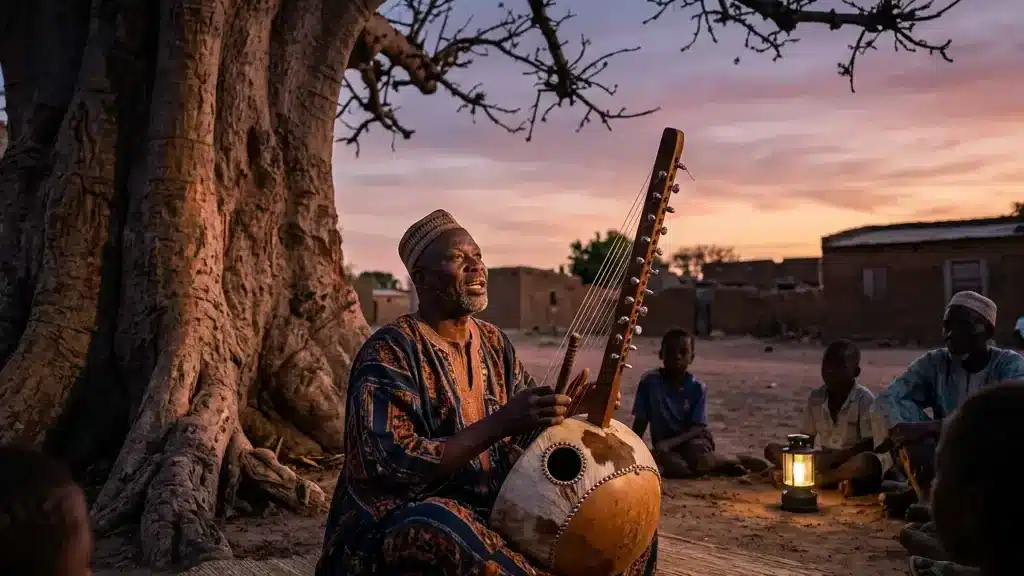
But what is a muse beyond the Greek tradition? The idea that creativity flows through us from a source beyond us is not Greek. It is ancient, and it belongs to every culture that has ever existed. In African tradition, the griot is the living embodiment of the muse — the keeper of stories, songs, and ancestral memory, whose voice carries the wisdom of generations into the present moment. The griot does not create from ego. The griot creates from lineage. From responsibility. The griot draws inspiration from the sacred understanding that the stories they carry belong not to them alone, but to everyone who came before and everyone who will come after.
Oshun: The Yoruba Muse of Creativity
In Yoruba tradition, the Orisha Oshun — goddess of rivers, creativity, beauty, and love — is one of the great muses of the African world. Artists, musicians, and healers call on her energy not as a metaphor but as a living spiritual force, capable of opening channels of creativity that the rational mind alone cannot access.
The Muse in Afro-Cuban Tradition: Lucumí and the Sacred Relationship
In Afro-Cuban Lucumí tradition — the living descendant of Yoruba spiritual practice that crossed the Atlantic with enslaved Africans — the relationship between a creative person and their spiritual source is maintained through ceremony, song, and sacred offering. The Orisha do not arrive uninvited. They respond to invitation, attention, and devotion. A musician or dancer who neglects this relationship finds their gifts growing thin. One who tends it finds themselves becoming a vessel for something that moves crowds, opens hearts, and reaches across generations.
The Muse in Afro-Brazilian Tradition: Candomblé and the Creative Axé
In Brazilian Candomblé, the word axé — sacred energy, spiritual power, the life force that flows through all things — is both the source of creativity and its measure. An artist operating from axé is not working from ego or technique alone; they are channeling a force that belongs to the community, the lineage, and the divine. Offerings, rhythm, and the cultivation of relationship with one’s guiding Orisha are not separate from the creative practice. They are the creative practice.
What both traditions share: the muse is not a passive fantasy. It is an active, reciprocal relationship that requires tending.
A muse, then, is any person, presence, force, or ancestral energy that opens you — that reaches into the place where your most authentic creative expression lives and says, “Come out.” It is time. We are ready.

The Four Types of Muses
Muses come in many forms. Knowing which muse resonates with you can help you find it and recognize it when it comes.
1. The Creative Muse
The most recognized form, this muse arrives through beauty, art, nature, music, or another person’s work. It is the painting that stops you in a gallery. The song that makes you pull over to the side of the road. The poem that rearranges something inside you permanently. The creative muse does not tell you what to make — it reminds you that making is possible.
2. The Emotional Muse
Grief, love, longing, rage, and joy: our deepest emotions are some of the most powerful creative forces we will ever encounter. The Emotional Muse does not ask to be comfortable. It asks to be expressed. In the African diasporic tradition, music born of sorrow — the spiritual, the blues, the samba — is proof that the emotional muse transforms what breaks us into what heals the world.
3. The Spiritual Muse
This is the muse that arrives in prayer, in ceremony, in the quiet just before dawn. It speaks through ancestral dreams, inexplicable synchronicities, and the feeling of being guided toward something greater than your ambition. The spiritual muse is deeply honored in Ubuntu philosophy — the understanding that our creativity is not ours alone but is in service to the community, the lineage, and the future.
4. The Ancestral Muse
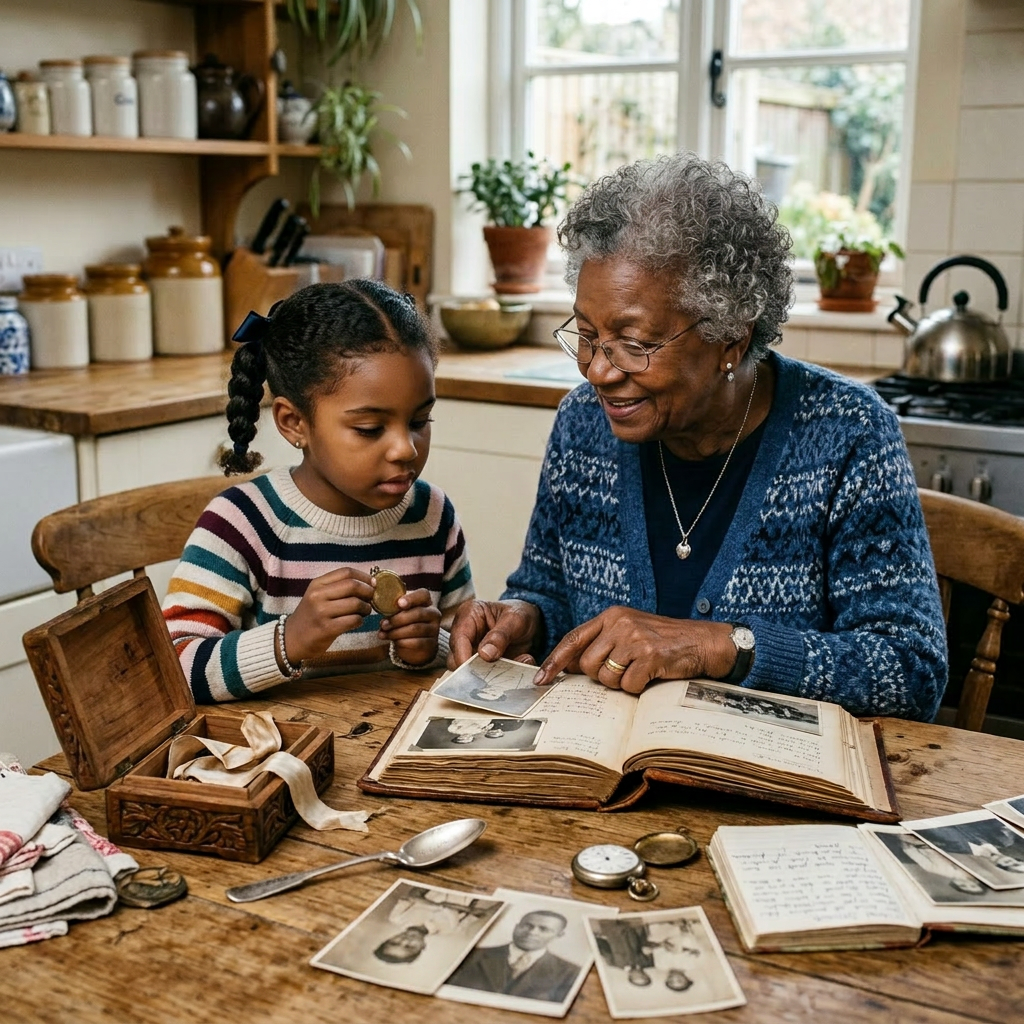
This spirit is the muse our traditions have always known best. It is the grandmother who shaped the clay with her hands. The great-uncle, whose voice brought a whole congregation to its feet, embodies this muse. The ancestor you never met whose gifts live in your hands, your voice, your way of seeing the world. The Ancestral Muse does not need to be remembered to be present. It lives in your body. It has been waiting all your life for you to pick up the work it started. What epigenetics is learning about ancestral memory gives scientific language to what African traditions have always practiced: that the dead are not truly gone, they live in our cellular memory, waiting for us to open the channel.
The Griot and the Ancestral Creative Tradition
Who Is the Griot?
Before we talk about how to find your muse, we need to talk about the griot — because understanding the griot changes everything about how we think about creativity, inspiration, and purpose.
The griot is the West African oral historian, storyteller, musician, and keeper of ancestral memory. In cultures across the Sahel and beyond — Mande, Wolof, Fulani, and Mandinka — the griot holds a sacred role. They are the living library of the community. The griot serves as the vessel that carries forward, renews, and makes present and useful the wisdom of the ancestors.
Model of Creativity – The Griot
The griot does not wait for inspiration to strike. The griot shows up for the wedding, the funeral, the coronation, and the harvest — and opens themselves as a channel. Their muse is the community itself. The ancestors speak through them. The occasion demands that something be created, right now, with everything they carry.
This is the Ubuntu model of creativity. Not the solitary genius in a garret, waiting for a lightning bolt. But the committed creative in the community who shows up, does the work, and trusts that what needs to come through them will come — because they have prepared the vessel.
Your muse is waiting for you to become that vessel.
Today’s digital tools — podcasts, community archives, social storytelling, and platforms like this one — can serve as a contemporary griot’s drum: technologies for carrying ancestral memory across distances of geography and time, making the wisdom of our lineages audible to people who have never heard them spoken aloud. The drum has simply changed form. The responsibility remains the same. When you publish your story, record your grandmother’s recipe, or share your people’s history online, you are grioting. The ancestors are watching. They approve.

How to Find Your Muse: 6 Ancestral Practices
Finding your muse is less about searching and more about creating the conditions for arrival. Here are six practices — rooted in both ancient wisdom and lived creative experience — that will open you to your muse.
1. Return to Your Ancestral Creative Practices
What did your people make? What did your grandparents’ hands do? Cooking, sewing, farming, singing, carving, drumming, storytelling — these are not hobbies. They are ancestral transmissions. When you pick them up, you are not learning something new. You are remembering something old. And the muse loves nothing more than a remembering.
2. Spend Time in Nature With Intention
Our ancestors did not separate the creative act from the natural world. The river, the forest, the night sky — these were not backdrops. They were collaborators. Go outside without your phone. Let your senses open. Ask the land what it wants to say through you. Then listen.
3. Create a Ritual Around Your Creative Practice
Light a candle. Play ancestral music. Set an intention. Speak the names of the creative ancestors who came before you. Ritual tells the spiritual world that you are serious. That you have made space. That you are ready. The muse responds to devotion.
4. Connect With Other Creatives in Community
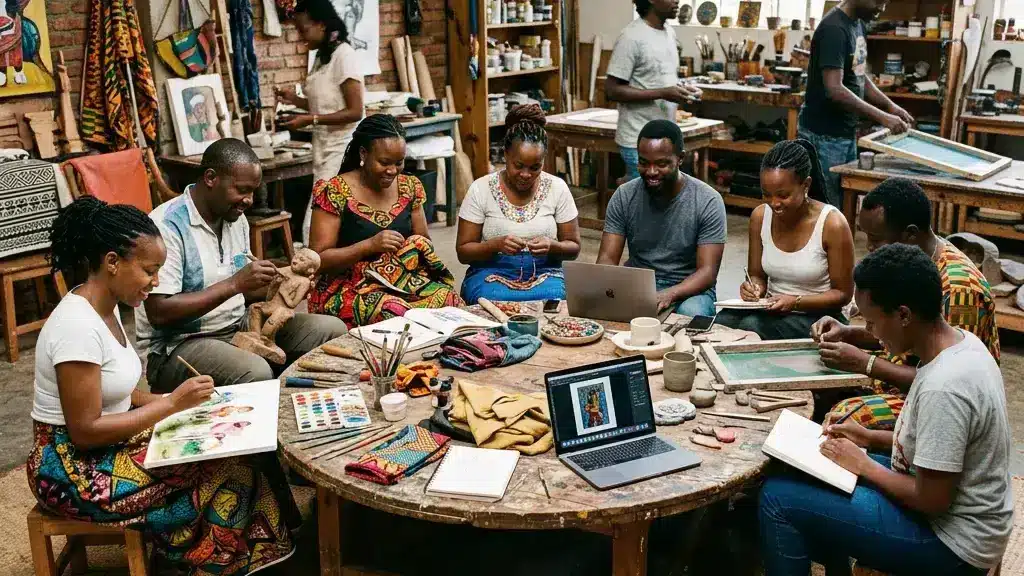
The Ubuntu creative tradition is inherently communal. Seek out other artists, writers, musicians, and healers — especially those rooted in diasporic and ancestral creative traditions. Your muse may arrive through the conversation you have after the performance. The collaboration that begins over a shared meal.
5. Unplug and Enter Stillness
The muse cannot compete with the noise of constant consumption. Put down the scroll. Turn off the sound. Sit with yourself in real silence — not the silence of empty distraction but the silence of genuine presence. The muse speaks in a whisper. Stillness is how you learn to hear it.
6. Keep a Journal of What Moves You
Not just what you think or plan, but what moves you. What made you cry unexpectedly? A piece of music stopped time? What memory surfaced for no apparent reason? These are messages. Your muse is already communicating with you. The journal is how you learn the language.
The Benefits of Having a Muse
Creativity Becomes Sustainable
When you are in a living relationship with your muse — when you have found the force, presence, or practice that reliably opens you to your most authentic creative expression — everything changes.
Creative blocks dissolve more quickly because you practice moving through them rather than waiting them out. Your work deepens, rooted in something tangible — your ancestral inheritance, your community, your spiritual life — rather than influenced by trends and market demand. Your creative life becomes sustainable because it is rooted in a relationship rather than performance.
Creativity Becomes a Gift
And perhaps most profoundly, your creativity becomes a gift rather than a burden. When you understand that what moves through you in your most inspired moments does not belong to you alone — it belongs to your lineage, your community, and the people who will be touched by what you make — the pressure lifts. You are not responsible for being a genius. You are responsible for being available.
Show up. Open the channel. Trust the muse. The ancestors did not carry their gifts all the way to you for you to leave them unopened.
3 Steps to Tending Your Muse
You do not find a muse once. You tend one — the way you tend a fire, a garden, a relationship. Here is where to begin today.
Open your journal, your instrument, your canvas — before you feel ready. The muse responds to presence, not perfection. The act of showing up is itself a prayer.
Ritual tells the spiritual world you are serious. Light a candle. Speak an ancestor’s name. Play a song that belongs to your people. These are not superstitions — they are invitations. The muse moves toward devotion.
Write down one thing that made you feel something — a memory, a sound, an image, a conversation overheard. This is your muse speaking. The more consistently you record it, the louder it becomes.
Ubuntu Reflection: Who or what has been your greatest muse — the person, place, ancestor, or experience that has most powerfully opened your creativity? Share in the comments. Your answer is part of someone else’s inspiration.
Related reading:
- Angel Lelahel: The Angel of Artistic Inspiration, Love, Fortune and Scientific Invention
- Music, Ritual, and the Science of Belonging
- The Science and Spirit of Ancestral Drumming
References
- Britannica Editors. (2026). Muse: Greek Mythology. Encyclopædia Britannica.
- Britannica Editors. (2009). Griot: West African Troubadour-Historian. Encyclopædia Britannica.
- Abdul-Fattah, H. (2020). How Griots Tell Legendary Epics Through Stories and Songs in West Africa. The Metropolitan Museum of Art.
- LéO Africa Institute. (2025). Keepers of Memory, Shapers of History: Who Are the Griots? LéO Africa Institute.
- Connolly Cove. (2026). Griots’ Legacy: Preserving West Africa’s Oral Traditions. Connolly Cove.
- Mark, J.J. (2021). Oshun. World History Encyclopedia.
- Britannica Editors. (2015). Oshun: Yoruba Goddess of Love, Fertility & Abundance. Encyclopædia Britannica.
- EBSCO Research Starters. Griot. EBSCO Social Sciences and Humanities Research Starters.
Community is the medicine.
The ancestors gave us creativity as a form of survival, connection, and resistance. Ubuntu Village keeps that flame alive by building spaces where our communities can create, heal, and be fully themselves — because the world needs what only we can make.
DonateAbout the author

Michele Mitchell
Founder, President & CEO — Ubuntu Village Inc.
Michele Mitchell is the Founder, President, and CEO of Ubuntu Village Inc., a 501(c)(3) nonprofit empowering communities across the African diaspora through ancestral wisdom, public health advocacy, and digital innovation — with active programs across East Harlem, Kenya, Uganda, and Nigeria.
Connect on LinkedInDiscover more from ubuntuvillageusa
Subscribe to get the latest posts sent to your email.